

Root Canal Procedure
Root canal therapy (RCT) is usually the best way to clear infections in a tooth’s root canal. During the root canal procedure, your dentist or endodontist will clean out the infected root canal and then seal it to prevent future infections.
If left untreated, an infected root canal, and subsequent abscessed tooth, can cause one or more of the following:
- Swelling that could spread to other areas of the face
- Bone loss around the tip of the root
- Drainage that can ooze into the gums and sometimes through the cheek into the skin
Here are the stages leading to an infected root canal:
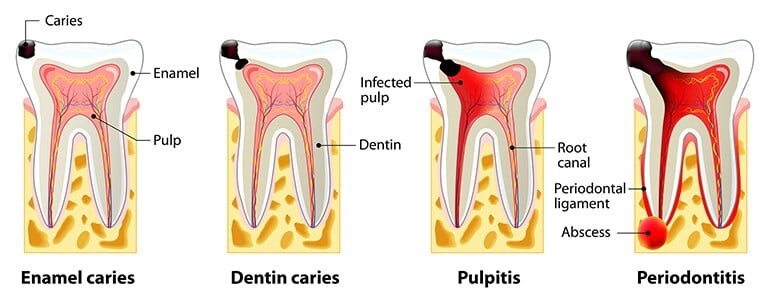
There are a few types of root canal procedures. Learn about them here:
Root Canals for Baby Teeth
There’s a common misconception that baby teeth don’t matter. However, baby teeth are crucial for healthy adult teeth to develop, so it’s important to address infected root canals and abscessed teeth before the issues spread and cause further damage to a child’s mouth. There are two types of pediatric root canal procedures: a pulpotomy and a pulpectomy. In a pulpotomy, the coronal part of the pulp is removed while in a pulpectomy procedure, the crown and the root canal of the pulp chamber is removed.
Pulpotomy
A pulpotomy, sometimes referred to as a baby root canal, is a root canal procedure typically used to treat infected baby teeth. Different from a pulpectomy, a pulpotomy restores and saves a tooth that’s infected by a deep cavity. It’s important to treat a deep cavity in a baby tooth to avoid the spreading of inflammation and infection that can cause an abscessed tooth and further issues down the road.
Pulpectomy
A pulpectomy is another root canal procedure performed on baby teeth. Depending on how far the infection of a root canal extends, a Dental Associates pediatric dentist or endodontist may perform a partial root canal. This procedure, called a pulpectomy, will relieve pain and allow time for antibiotics to reduce the infection. At an initial appointment, the endodontist will administer antibiotics to reduce the infection. At a second appointment, the endodontist will remove the infected pulp, and clean and fill the infected canal so the primary tooth can stay in the mouth and ensure proper growth and placement of the incoming secondary (adult) teeth.
Root Canals for Adults
Pulpectomy
A pulpectomy can be performed on an adult tooth as well as a baby tooth. A pulpectomy involves the complete removal of pulp tissue in a tooth as the first step in root canal treatment. This procedure will remove all the infected pulp, both in the crown portion of the tooth and the roots, to preserve as much of the natural tooth as possible.
Apicoectomy
An apicoectomy is the root canal procedure typically used to treat an abscessed tooth in adults. They’re performed on teeth that already had a root canal completed but the original root canal was not successful in eliminating the infection. In an apicoectomy, a dentist will remove a portion of the root tip as well as the apical infection. Once your dentist removes the infected tissue and cleans the entire area, the canal is filled with a biocompatible material called Gutta Percha, which is a rubber-like material that seals your tooth from bacteria and reinfection.
Root Canal - What to Expect
For most people, it’s hard to know what to expect for a root canal, especially if you’ve never had one before. You’ve probably heard other people talking negatively about a root canal procedure, but it shouldn’t be scary. With modern technology and our caring endodontists, your experience will exceed your expectations. You may say it’s even less concerning than a performance review at work!
A root canal procedure can take anywhere from a half-hour to a few hours, depending on the complexity of the root canal system of the tooth and the level of disease present. Your mouth will be completely numb so you won’t feel anything, and we’ll make sure you’re doing okay every step of the way. Some patients say that a root canal procedure doesn’t seem much different from a general filling—it’s just a little bit longer of a procedure.
Before your root canal procedure, try not to worry and think too much about it. The more you worry, the more you’ll psyche yourself out and expect the worst. Know that you’re in good hands with our Dental Associates endodontists and we’ll make sure you’re comfortable the whole time!
Hear what one of our endodontists has to say about root canals and what to expect by watching this short video:
Root Canal Recovery
Our caring dentists and endodontists will ensure that your root canal therapy care extends beyond the procedure and will help manage any post-procedure pain you may have. To help with root canal recovery, you may be prescribed pain relievers or an antibiotic depending on the status of the remaining pulp and the amount of swelling.
Your tooth may be sensitive for the first few days following root canal therapy. This is natural and will reside after a few days. In the meantime, it is best to minimize chewing on the treated tooth until your root canal therapy is completely finished and the permanent filling or dental crown is in place. Treating it gingerly will help manage the pain, promote healing, and prevent breakage of any temporary crown.
Root canal therapy is highly successful and has more than a 95% success rate. To ensure that your restored tooth remains in good condition, you should treat it like every other tooth in your mouth. Be sure to brush and floss it and see your dentist twice per year for routine exams and cleanings.
Get Started Today!
Think you may need a root canal procedure? Request an appointment and one of our caring endodontists will be happy to help relieve you of any pain.

Call a Clinic
Find a Location
Find a Dentist
Pay My Bill
Patient Resources
Dental Services
Insurance & Financing
Family Owned
